
Creating Scans for Sourcery: A Step-by-Step Guide

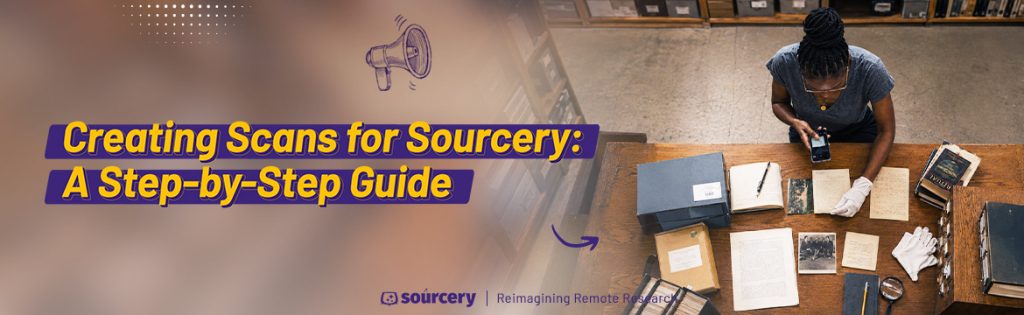
Use this quick reference guide to help you create scans for fulfilling Sourcery requests! See “More Resources” for a more detailed guide as well as links to other Sourcerer resources.
First, a refresher on “reference quality:”
Remember that Sourcery is intended to be a resource for researchers to get reference quality scans of undigitized materials.
Reference quality means the scans should be:
- Legible
- Clear
- Straight
- Well lit
- Complete
Reference quality means the scans should not be:
- Reproduction quality
- Digitization quality
Now, let’s begin!
To create the clearest possible scans, abide by the following general guidelines:
1. Set the document directly on the table. This will accomplish a few things:
- It will be easier for your scanning app to identify the edges of the document
- Eliminate bleed through from documents underneath the one you’re attempting to scan
- Provides a clean and un-cluttered environment for working
2. Lay the document so it’s straight. Use the edge of the table as a guide to place the document straight in front of you.
3. Take the scan from directly above the material. Stand directly above the material with your phone parallel to the table. This will generate a flat scan and minimize shadows and distortion.
4. Hold still. When creating the scan, try and hold as still as possible. Holding still will hopefully keep the resulting scans from being too blurry.
5. Triage each scan. Before moving on to the next page, take a second to check that the scan is of the proper quality.
6. Trim any unnecessary margins. This won’t be an issue with most scanning apps, but take a second to double check the cut-off of your scans. Large margins can get unwieldy for Researchers and can make the scans more difficult to use.
7. Work with the archive & the document’s preservation concerns. Some material might come enclosed in plastic sleeves, be very fragile, have creasing from being folded for long periods of time, and more. While working in the archives it’s important to ensure you are treating the material gently and following proper preservation protocol.
- For volumes, use any preservation supports provided to you by reference staff. This can include supports or bolsters to place under the volume to help keep strain off of a fragile spine.
- For material in plastic sleeves, ask the reference desk staff if you can remove the document from the enclosure to take a cell phone scan. Most repositories will allow you to do this.
- For extremely fragile material, handle with care. Try to touch the material as little as possible, especially if it’s very dry and crumbly. If you decide to remove the material from the folder for a scan, always have a plan for where you will place it; never pick up fragile material with no plan for where you will be setting it down.
- For material that is very fragile, do not press down to remove creases. Take multiple scans to try and capture as much of the material as possible, but do not force brittle paper to bend.
- For material with deep creases, such as letters or pamphlets, try to very gently press down on any creases so they lay flat. You might have to gently hold the pages down while you scan. Ask the reference desk staff if they have book weights (sometimes called snakes) that you can borrow. Use these to gently hold down pages while you scan to protect delicate pages from sweat and oils on your hands. Again, do not do this on fragile, brittle, or exceedingly dry material.
Once you’ve completed creating your scans, you’ll need to export them into a collated PDF to upload into Sourcery. Uploading files is easy, but we have resources if you need them.
More Resources:
- Read a more detailed version of this guide in our Sourcerer Handbook
- Get help choosing a document scanning app
- Learn how to upload scans into Sourcery
- Read about proper archival etiquette