
Sourcery Research Ambassador: Meet Maddie!

👂Have you heard? We’re recruiting 5 Sourcery Research Ambassadors to help us test new features and expand into the Washington, DC metro area! If you’re a humanities researcher and are in need of archival materials from Washington, DC-based repositories, apply now! Read more in our previous blog post: https://sourceryapp.org/2025/09/17/join-our-team/
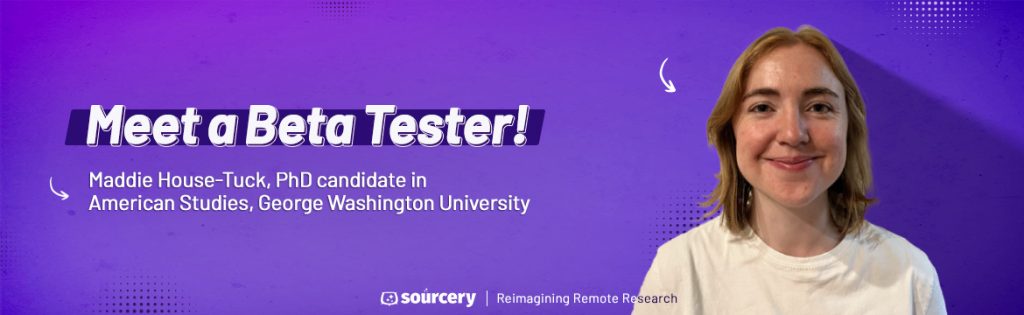
And now, our featured blog post: learn about how Sourcery can help you, written by previous Sourcery Research Ambassador Maddie House-Tuck!
“I do archival research,” is a phrase I heard a lot when I first started graduate school. For the first
year (maybe two) of my program, I struggled to understand what exactly this meant. What is an
“archive” precisely? How do you locate the files you need to see, and when do you start traveling
to see them? What do you bring to an archive? How and when should you start communicating
with an archivist in advance? Do I take photographs of files with my phone, or do I scan them? I
often felt embarrassed to ask questions like these, and assumed that the answers should be
somewhere in the back of my mind if I was a “real” scholar. Now, as someone who does claim to
“do archival research,” I admittedly still ask myself some of these questions, and find myself
frustrated with how the nitty-gritty aspects of doing archival research are frequently taken for
granted. Learning these skills should be a facet of any graduate education in the humanities or
social sciences.
Sourcery is opening the door to having more frank conversations about how research
communities use and talk about archives. As a beta-tester for Sourcery this past summer, I
greatly enjoyed having conversations with the Sourcery team and other beta-testers about how to
communicate effectively about archives and how to honor all the idiosyncrasies of archival
research. Applications like Sourcery work towards making the experience of using archives more
transparent, as well as fully realizing the labor that goes into accessing and maintaining archival
repositories. Learning how to use Sourcery is in and of itself an exercise in thinking about
archives, archival management, and what we really need to make archival research possible.
These needs of often included money and time, in addition to proper knowledge about archival
materials. As a teaching assistant and graduate student, it can be challenging to budget resources
to make the archival trips I need. Finding weeks at a time where I can relocate to New York to do
research has proved nearly impossible, and accessing the funds to do so often means competing
for fellowships, grants, and/or dipping into my personal savings. I often find myself in a position
where I have to make difficult research calculations, while sometimes letting some research leads
fall by the wayside. Sourcery begins to tangibly eliminate these challenges. It greatly enhances
research accessibility, and it has already given me the opportunity to view files that I was
preparing to wait for additional funding to see. When I mention what Sourcery has made possible
for me to fellow colleagues and graduate students, nearly everyone expresses excitement to add
the application into their research repertoire. It is leveling the research playing field in real time,
and presenting new opportunities for graduate students and early career scholars.
Sourcery is bound to make a large impact on the research world, and it won’t be long before it
becomes a household name for all of us accessing archives. From opening up conversations
around how archives work and how to communicate about them effectively, to enhancing
research accessibility, the application is a testament to what’s possible when we take innovation
in the research community seriously. I’m looking forward to the day when “making a Sourcery
request” is par for the course in humanities research, and a refrain similarly as common as “I do
archival research.”
Maddie House-Tuck is a PhD candidate in American Studies at George Washington University,
where she teaches and conducts research on 20th century policing and live event cultures. She
also holds a Masters in Theater and Performance Studies from Washington University in St.
Louis. Over the summer, Maddie was able to use Sourcery to compile the final pieces of research for
the third chapter of her dissertation. These materials have allowed her to move forward on her
project earlier than expected, and offered new research leads for her to follow!